







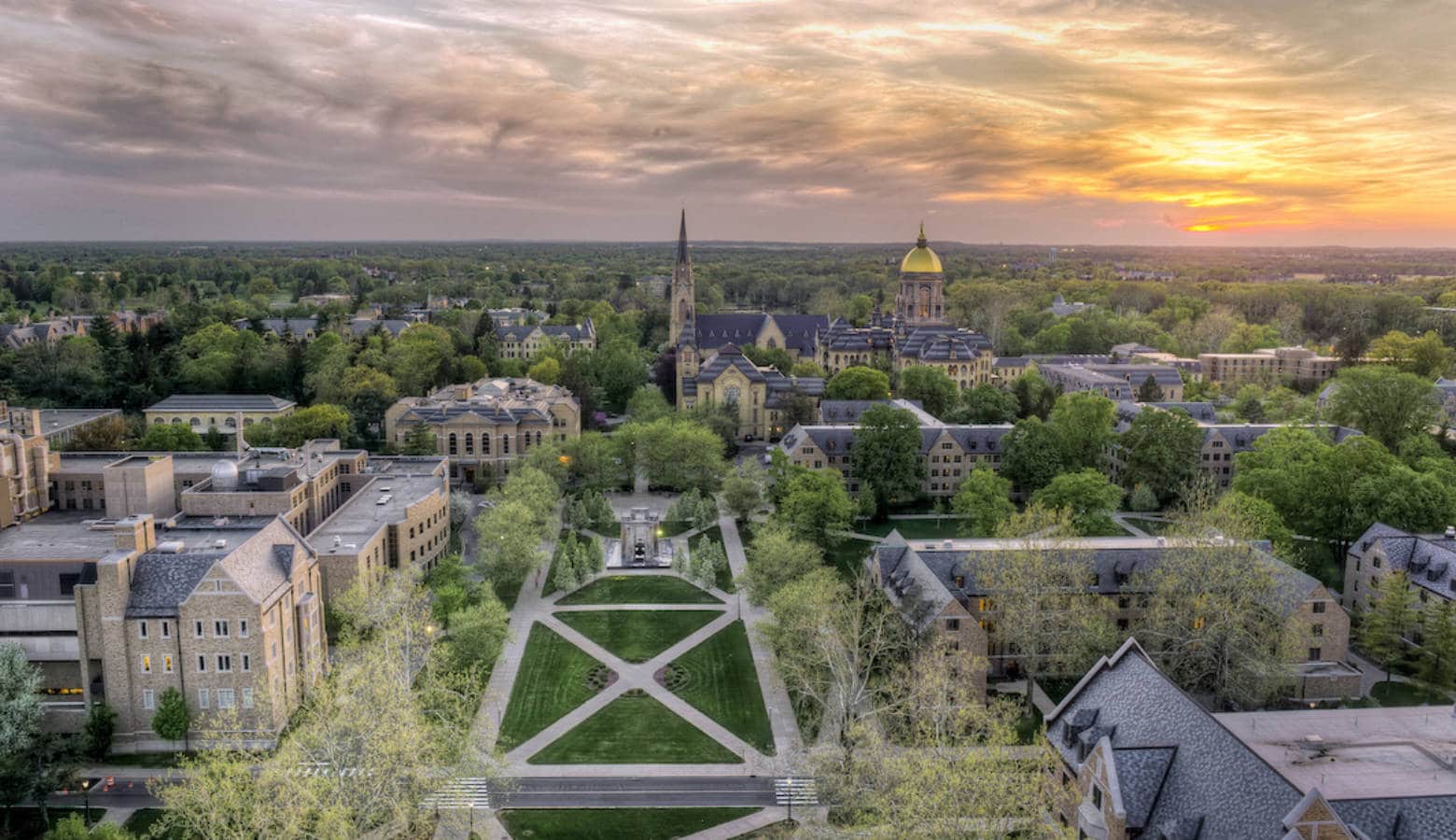
The best colleges in Indiana for 2027 are Notre Dame, Purdue, and Indiana University Bloomington. Each school offers different programs and majors, and tuition and scholarship opportunities vary widely, so it’s worth researching each one.
The Midwest has many colleges and universities, and Indiana packs a lot of range into one state, from big research universities to small liberal arts colleges. Read the University Magazine rankings methodology and see our university rankings for context.
The Best Colleges In Indiana 2027
1. University of Notre Dame

The University of Notre Dame is a private Catholic research university in Notre Dame, Indiana. Father Edward Sorin of the Congregation of Holy Cross founded it in 1842. About 13,000 students enroll, and the Class of 2030 admission rate was 9 percent. It is an R1 institution with an endowment of about $20 billion.
Seven colleges and schools cover arts and letters, science, law, architecture, engineering, business, and global affairs. The Golden Dome and the Basilica of the Sacred Heart are the campus landmarks. U.S. News ranked Notre Dame 20th among national universities in 2026 and 10th for undergraduate teaching. The Fighting Irish play football as an independent and most other sports in the ACC.
2. Purdue University

Purdue University is a public research university in West Lafayette, chartered in 1869 and open for classes in 1874. The campus covers 2,660 acres, and fall 2025 enrollment was listed at about 57,900. It has 10 colleges and schools and is an R1 member of the Association of American Universities.
Engineering is the signature program, and U.S. News ranked it fourth among doctorate-granting engineering schools. Purdue offered the country’s first four-year aviation degree, and 27 graduates have become astronauts, including Neil Armstrong and Eugene Cernan. If aerospace is on your list, see our best colleges for aerospace engineering. The Boilermakers compete in the Big Ten.
3. Indiana University – Bloomington

Indiana University-Bloomington began in 1820 as the State Seminary, and classes started in 1825. It is the flagship of the IU system, an R1 research university with roughly 48,400 students in fall 2024 on a campus of about 1,900 acres. U.S. News ranked it 73rd among national universities in 2026.
The Kelley School of Business, the Jacobs School of Music, the Media School, and the O’Neill School of Public and Environmental Affairs are the best-known units. The Hoosiers have played in the Big Ten since 1899, and the men’s basketball team has won five national championships. Bloomington is a college town through and through, which many students count as a plus.
4. Wabash College

Wabash College is a small men’s liberal arts college in Crawfordsville, founded in 1832. It is one of only three non-religious, all-male, four-year colleges in the country. About 835 undergraduates study on a 65-acre campus, and U.S. News ranked it 50th among national liberal arts colleges and fifth for undergraduate teaching in 2026.
Seniors take comprehensive exams in their major, and the college follows a single guiding rule, the Gentleman’s Rule, rather than a long code of conduct. The Little Giants field 13 varsity teams in NCAA Division III. Each fall, they play ePauw in the Monon Bell Classic, a rivalry dating to 1890 that has been held every year since 1911, with a few exceptions.
5. Indiana University Indianapolis
Indiana University Indianapolis was created on July 1, 2024, when IUPUI split into IU Indianapolis and Purdue University Indianapolis. It sits on 536 acres downtown and was elevated to R1 status in February 2025. As IUPUI, it enrolled about 29,400 students in fall 2020.
The IU School of Medicine is based here and is described as the country’s largest medical school. Indiana’s only dental school, the IU School of Dentistry, along with the McKinney School of Law and a Kelley School of Business campus, are also on site. The Jaguars compete in NCAA Division I in the Horizon League. The Natatorium is the largest indoor pool in the country.
6. Rose-Hulman Institute of Technology

Rose-Hulman Institute of Technology is a private engineering and science college in Terre Haute on 1,300 acres. It opened in 1874 as the Terre Haute School of Industrial Science. About 2,200 undergraduates enroll, and the student-faculty ratio is 11:1.
It focuses on undergraduate teaching, with a small master’s program and no doctoral programs. U.S. News ranked it first among engineering colleges that do not offer a doctorate for 27 years in a row, as of 2025. Alumni include NASA center director Abe Silverstein and former Caterpillar CEO Jim Umpleby. Students get small classes and plenty of hands-on project work. The Fightin’ Engineers compete in NCAA Division III.
7. Indiana University – East
Indiana University East in Richmond started in 1967 as the Eastern Indiana Center of Earlham College and became IU East in 1971. About 3,500 students attend, almost all of them undergraduates, on a 174-acre campus near Interstate 70.
It offers more than 60 bachelor’s and master’s programs through five schools: business and economics, education, humanities and social sciences, natural science and mathematics, and nursing and health sciences. Some degree-completion programs run online. The Red Wolves compete in the NAIA River States Conference and field 17 varsity sports, eSports included. The compact campus suits students who want close contact with faculty.
8. Purdue University Northwest
Purdue University Northwest (PNW) formed in 2016 when Purdue University Calumet and Purdue University North Central merged. The 167-acre Hammond campus sits about 25 miles from downtown Chicago, and a 268-acre branch campus in Westville serves La Porte County. Fall 2024 enrollment was about 9,050.
Its colleges cover business, engineering and sciences, humanities and education, nursing, and technology, and the White Lodging School of Hospitality and Tourism Management stands out. There is also an Honours College. The Pride compete in NCAA Division II in the Great Lakes Intercollegiate Athletic Conference and offer 11 varsity sports. Its location near Chicago gives students access to a big job market without big-city rent.
9. Earlham College
Earlham College is a Quaker liberal arts college in Richmond, founded in 1847 as the Friends Boarding School. It adopted the name Earlham in 1859. About 680 students enroll on an 800-acre campus, which makes it one of the smallest schools on this list.
Biochemistry, biology, business, neuroscience, and psychology are popular majors, and about 70 percent of students join an off-campus program. The Earlham School of Religion is an affiliated graduate seminary, and students run the public radio station WECI 91.5. U.S. News tied it for 74th among national liberal arts colleges in its 2025 to 2026 edition. The Quakers play NCAA Division III.
10. Goshen College
Goshen College is a Mennonite liberal arts college in Goshen. It began in 1894 as the Elkhart Institute and moved to Goshen in 1903. Mennonites make up about 30 percent of students, though the college welcomes students of every faith. Enrollment is around 950.
It offers 46 majors and 52 minors, with nursing, biology, business, communication, education, and American Sign Language among the popular choices. Students either spend a semester abroad or complete an intercultural experience in the United States, and about 80 percent do it through the Study-Service Term. The Maple Leafs compete in the NAIA Crossroads League with 14 varsity sports.
11. Indiana University – Kokomo
Indiana University Kokomo opened in 1932 as Kokomo Junior College and became an Indiana University center in 1945. It sits on 51 acres in north-central Indiana and had about 3,100 students in 2020. The Higher Learning Commission accredits it.
IU Kokomo offers more than 60 IU degrees, including bachelor’s programs in medical imaging technology and criminal justice, and master’s programs in public management, business, and nursing. Schools cover allied health, business, education, humanities and social sciences, nursing, and sciences. The Cougars compete in the NAIA River States Conference with 14 varsity sports. The Student Activities and Events Center opened in 2020, and the campus suits students who want a smaller IU school close to home.
12. Taylor University

Taylor University is a Christian university in Upland, on about 950 acres. It began in 1846 as Fort Wayne Female College under the Methodist Church and moved to Upland in 1893. In 2024, it enrolled 1,901 undergraduates and 436 distance learners.
Students choose from 61 majors, with education, business, new media, and exercise science among the most popular. Study abroad programs run in Cuenca, Ecuador, and Belfast, Northern Ireland. The Trojans compete in the NAIA Crossroads League with 16 varsity sports, and the men’s cross country team won the national title in 2020, followed by the women’s team in 2022. The wooded Upland campus and nature trails add to its appeal.
13. University of Evansville

The University of Evansville is a United Methodist university that began in 1854 as Moores Hill College and moved to Evansville in 1919. It enrolled 2,109 students in fall 2023. Its British campus, Harlaxton College, is housed in Harlaxton Manor in Lincolnshire, England.
The American College of Sports Medicine endorses the exercise science program, and the Dunigan Family Department of Nursing is accredited by the Indiana State Board of Nursing. Theatre students perform at the 482-seat Shanklin Theatre. U.S. News ranked it seventh among Midwest regional universities in 2022. The Purple Aces compete in NCAA Division I in the Missouri Valley Conference.
14. DePauw University

DePauw University is a liberal arts university in Greencastle, about 45 miles west of Indianapolis. It started in 1837 as Indiana Asbury College and took the DePauw name in 1884. About 1,800 students enroll; the student-faculty ratio is 10 to 1, and the average class has 17 students.
The calendar includes a Winter Term and a May Term, and the Institute of Music grants bachelor’s degrees in music. The Rector Scholar Program, begun in 1919, rewards academic achievement and character. Popular majors include economics, rhetoric, computer science, biochemistry, and psychology. U.S. News ranked DePauw 50th among liberal arts colleges in 2025. The Tigers play NCAA Division III.
15. Valparaiso University

Valparaiso University (Valpo) is an independent Lutheran university in northwest Indiana, founded in 1859. In fall 2025, it enrolled 2,451 students, 2,071 of whom were undergraduates. Five undergraduate colleges cover arts and sciences, business, engineering, nursing and health professions, and Christ College, its honours college.
The Chapel of the Resurrection sits at the center of campus and has been a landmark since 1959. U.S. News tied Valpo for 15th in undergraduate engineering among schools without doctorates in 2025. The law school closed in 2020. The Beacons, renamed in 2021, play NCAA Division I in the Missouri Valley Conference. Together,r they cover most major career paths.
16. Manchester University
Manchester University is a Church of the Brethren school in North Manchester. It started in 1860 as Roanoke Classical Seminary and has about 1,175 students. A second campus in Fort Wayne hosts the Doctor of Pharmacy program and master’s programs in pharmacogenomics, athletic training, and nutrition.
Manchester launched the Peace Studies Institute in 1948 and is described as home to the first undergraduate peace studies major in the United States. Social responsibility and service run through campus life. An accelerated second-degree nursing program is also based in Fort Wayne. The Spartans compete in NCAA Division III in the Heartland Collegiate Athletic Conference.
17. Butler University

Butler University is a private university on 295 acres about five miles north of downtown Indianapolis. It opened in 1855 as North-Western Christian University and was founded by members of the Disciples of Christ. About 5,800 students enrolled in 2024.
The college includes the Lacy School of Business, the Jordan College of the Arts, and the College of Pharmacy and Health Sciences. U.S. News ranked Butler first among Midwest regional universities in 2024. Built in 1928, Hinkle Fieldhouse is one of the country’s great basketball arenas. The Bulldogs reached the national championship game in 2010 and 2011 and now play in the Big East.
18. Indiana University Southeast
Indiana University Southeast in New Albany sits about 15 minutes north of downtown Louisville, Kentucky, on 177 acres. It opened in 1941 as the IU Falls City Area Center and took its current name in 1968. Its latest listed enrollment was about 5,200 in 2017.
It offers more than 55 degree programs from associate to master’s level and is best known for business, nursing, and education. It is the only university in the Louisville area offering a bachelor’s degree in journalism. Six schools house its programs. The Grenadiers compete in the NAIA River States Conference with ten varsity sports. Its Louisville-area location is a big part of the appeal.
19. Indiana University – South Bend
Indiana University South Bend began in 1916 as an extension of the Bloomington campus. It is the northernmost IU campus, spread over 80 acres along the St. Joseph River. Fall 2022 enrollment was 4,326.
Programs are offered through the Raclin School of the Arts, the Judd Leighton School of Business and Economics, the School of Education, the Dwyer College of Health Sciences, the College of Liberal Arts and Sciences, and the School of Social Work. The campus also hosts a branch of the Purdue College of Technology. The Titans compete in the NAIA with eight varsity sports. Its urban campus sits along the river in South Bend.
20. University of Southern Indiana
The University of Southern Indiana opened in 1965 as a regional campus of Indiana State University in Evansville and became its own four-year university in 1985. About 9,300 students enrolled in fall 2023 on a 1,400-acre campus west of the city.
Four colleges cover liberal arts, business, nursing and health professions, and science, engineering, and education. The Romain College of Business and the College of Nursing and Health Professions draw many students. The Screaming Eagles moved from NCAA Division II into Division I and compete in the Ohio Valley Conference. Its 1,400 acres give it far more space than most Indiana campuses.
21. Ball State University
Ball State University in Muncie opened in 1918 as the Indiana State Normal School, Eastern Division. Its Teachers College is still the oldest of its colleges. Fall 2023 enrollment was 20,440, including 14,874 undergraduates, and it is classified as R2.
Immersive learning is a signature idea here. The university reports over 1,250 projects that have reached all 92 Indiana counties, with students working on real problems for real clients. The Cardinals compete in NCAA Division I FBS in the Mid-American Conference. Washington Monthly ranked Ball State 133rd among national universities in 2024. Its Teachers College, founded in 1918, remains a major draw for future educators.
22. Indiana University – Northwest
Indiana University Northwest in Gary opened in 1963 and is one of seven regional IU campuses. About 3,200 students enrolled in fall 2022, including 2,860 undergraduates. It has around 29,000 alumni.
Six schools and colleges offer 70 undergraduate degree programs, and more than 200 degrees, certificates, and pre-professional tracks. Students in northwest Indiana can stay close to home and still earn an IU degree, with more than 200 options. The RedHawks compete in the NAIA Chicagoland Collegiate Athletic Conference with seven varsity teams. As the only IU campus in Gary, it also serves as a hub for the surrounding community.
23. Marian University Indianapolis
Marian University is a Catholic university in Indianapolis, about four miles northwest of downtown. The Sisters of St. Francis founded it in 1851 in Oldenburg, and it moved to Indianapolis in 1937. It was Marian College until July 1, 2009. Enrollment is about 3,600.
The Tom and Julie Wood College of Osteopathic Medicine opened in 2013 and is Indiana’s first Catholic osteopathic medical school. Six schools and more than 40 majors cover business, arts and sciences, education, nursing, and engineering. Ancilla College merged with Marian in 2021. The Knights field 24 varsity teams in the NAIA, and the football team won national titles in 2012 and 2015.
24. University of Saint Francis – Indiana
The University of Saint Francis is a Catholic, Franciscan university in Fort Wayne, on 132 acres, with a satellite site in Crown Point. It began in 1890 in Lafayette as Saint Francis Normal School and moved to Fort Wayne in 1944. It became a university in 1998.
About 1,900 students enrolled in fall 2022, roughly 1,600 of them undergraduates. Its academic units include the Division of Creative Arts, accredited by the National Association of Schools of Art and Design, the College of Health Sciences, and the College of Arts, Sciences and Business. The Cougars compete in the NAIA Crossroads League.
25. Indiana Wesleyan University-Marion
Indiana Wesleyan University is an evangelical Christian university affiliated with the Wesleyan Church. It opened in 1920 on a 350-acre campus in Marion. About 2,000 students attend classes there, but total enrollment is around 15,000 because of its large adult and online programs.
The School of Nursing is one of five principal academic units, and Wesley Seminary adds about 700 graduate students. If online study appeals to you, see our guide to the best online colleges in Indiana. The Wildcats compete in the NAIA Crossroads League. U.S. News ranked IWU 13th among Midwest regional universities in 2022. The Marion campus is the traditional residential center, while the National and Global division serves adult and online learners.
Frequently Asked Questions
What are the best colleges in Indiana in 2027?
The University of Notre Dame, Purdue University, Indiana University Bloomington, Wabash College, and Indiana University Indianapolis lead this University Magazine list for 2027.
What is the largest university in Indiana?
Purdue University had about 57,900 students in fall 2025, and Indiana University Bloomington had about 48,400 in fall 2024. Ball State had 20,440 in fall 2023.
Which Indiana colleges play in the Big Ten?
Purdue University and Indiana University Bloomington both compete in the Big Ten Conference at the NCAA Division I level. Notre Dame plays most sports in the ACC.
Which Indiana colleges are small liberal arts schools?
Wabash College, DePauw University, Earlham College, and Goshen College are all small liberal arts schools on this list.
Which Indiana colleges are best for engineering?
Rose-Hulman Institute of Technology ranked first among engineering colleges without a doctorate for 27 years as of 2025. U.S. News ranked Purdue University fourth among doctorate-granting engineering schools.
Top 25 Best Colleges in Indiana 2027: Ranked List
- University of Notre Dame
- Purdue University
- Indiana University – Bloomington
- Wabash College
- Indiana University Indianapolis
- Rose-Hulman Institute of Technology
- Indiana University – East
- Purdue University Northwest
- Earlham College
- Goshen College
- Indiana University – Kokomo
- Taylor University
- University of Evansville
- DePauw University
- Valparaiso University
- Manchester University
- Butler University
- Indiana University Southeast
- Indiana University – South Bend
- University of Southern Indiana
- Ball State University
- Indiana University – Northwest
- Marian University Indianapolis
- University of Saint Francis – Indiana
- Indiana Wesleyan University-Marion
Read more about UM World University Rankings




 University Magazine is part of the

