







The best colleges in Massachusetts for 2027 are MIT, Harvard University, and Williams College. Massachusetts is known for its top schools, with many accredited colleges and universities to choose from.
This guide will help you find the best college for you, whether you want a large research university, a small liberal arts college, or a school built around a single field. Read the University Magazine rankings methodology and see our university rankings for context.
The Best Colleges In Massachusetts 2027
1. Massachusetts Institute of Technology

The Massachusetts Institute of Technology (MIT) is a private research university in Cambridge. Its charter was signed on April 10, 1861. In fall 2025, it enrolled 11,816 students, 4,561 of them undergraduates, and recent admit rates have run around 4 to 5 percent. It is an R1 institution with a $27.4 billion endowment.
The academic structure includes five schools and one college, the Schwarzman College of Computing. As of October 2024, 105 Nobel laureates had been affiliated with MIT. The Undergraduate Research Opportunities Program, begun in 1969, places most undergraduates in faculty labs for credit, pay, or volunteer work. The Engineers compete in NCAA Division III.
2. Harvard University

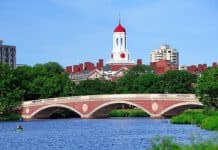
Harvard University was founded in 1636 and is the oldest institution of higher learning in the United States. It sits in Cambridge, across the Charles River from Boston. In fall 2024, it enrolled 21,189 students, 7,038 of them undergraduates, across 13 schools, including medicine, law, business, and divinity.
The endowment was $55.7 billion in 2025, and the library system holds more than 20 million volumes. The Academic Ranking of World Universities has placed Harvard first every year since 2003, and Times Higher Education has done so since 2011. The Crimson competes in NCAA Division I as an Ivy League school.
3. Williams College

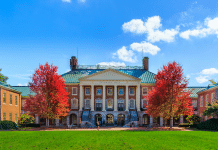
Williams College is a liberal arts college in Williamstown, in the Berkshires, chartered on June 22, 1793. It enrolled 2,150 students in fall 2024, and the admission rate is 8.3 percent. U.S. News has ranked it first among national liberal arts colleges every year since 2004.
Tutorials are a signature. Two students meet weekly with a professor, with ten students per tutorial in five pairs. Every year, 26 juniors spend the year at Exeter College, Oxford, through the Williams-Exeter Programme, founded in 1985. The Ephs compete in NCAA Division III in the NESCAC, and Williams is part of the Little Three with Amherst and Wesleyan. The endowment is $3.93 billion.
4. Boston University

Boston University (BU) began on April 24, 1839, as the Newbury Biblical Institute and was chartered as Boston University in 1869. Fall 2025 enrollment was 38,093, with 18,253 undergraduates, across 17 schools and colleges. It is an R1 research university with a $4.05 billion endowment.
The main Charles River Campus runs along the river through Boston’s Fenway-Kenmore and Allston neighbourhoods. U.S. News ranked BU 42nd among national universities in its 2026 edition, and QS ranked it 88th in the world that year. The Terriers compete in NCAA Division I in the Patriot League, with hockey in Hockey East. Times Higher Education ranked it 76th in the world for 2026.
5. Amherst College

Amherst College is a liberal arts college in Amherst, founded in 1821. It enrolled 1,914 undergraduates in fall 2024, and its fall 2025 admissions rate was about 7.7 percent. It has no core curriculum and no distribution requirements, so students shape their own path.
Through the Five College Consortium, Amherst students can take classes at Smith, Mount Holyoke, Hampshire, and UMass Amherst at no extra tuition cost. The Wall Street Journal and College Pulse ranked it the best liberal arts college in their 2024 rankings. Students interested in health fields might also check out our best colleges for dental. The Mammoths play NCAA Division III in the NESCAC.
6. Northeastern University

Northeastern University began in 1898 as the Evening Institute for Younger Men of the Boston YMCA and became Northeastern in 1922. Fall 2025 enrollment was 38,403, including 22,456 undergraduates. It is an R1 university with campuses in Boston, London, Toronto, Vancouver, and other cities.
Co-op started in 1909, and U.S. News has ranked Northeastern first for co-ops and internships every year from 2020 to 2026. That path pairs well with sports and campus life, and our guide to the best college dorms in Massachusetts covers housing. The Princeton Review also ranked it first for internships in 2024, 2025, and 2026. For health programs, see our best colleges for physiotherapy.
7. Boston College

Boston College is a Jesuit Catholic research university founded in 1863. Its 175-acre campus sits in Chestnut Hill, about six miles west of downtown Boston. In fall 2024, it enrolled 15,234 students, including 9,654 undergraduates. Nine colleges and schools include the Carroll School of Management, the Lynch School of Education and Human Development, and the Connell School of Nursing.
U.S. News tied BC for 39th among national universities in its 2023 to 2024 edition. It is an R1 institution. The Eagles compete in NCAA Division I in the Atlantic Coast Conference, which they joined for the 2005 to 2006 season. Students weighing schools in other states can also consider Kentucky’s best colleges.
8. Tufts University

Tufts University was founded in 1852 as Tufts College and became a university in the mid-1950s. The main campus spans Medford and Somerville, with additional sites in Boston, Grafton (for veterinary medicine), and Talloires, France. It enrolled 13,599 students in fall 2024.
It has ten schools, including the Fletcher School of Law and Diplomacy, founded in 1933 and often called the country’s oldest graduate school of international relations. Tufts is an R1 university and an AAU member. The admission rate was 10.5 percent for the Class of 2029, and U.S. News ranked it 31st nationally in 2026. The Jumbos play in the NESCAC.
9. Wellesley College

Wellesley College is a women’s liberal arts college chartered in 1870 that opened in 1875. It enrolled 2,285 undergraduates in fall 2025, and the Class of 2028 offer rate was 13 percent. The 500-acre campus overlooks Lake Waban, and there are 60 majors.
The Davis Degree Program lets women over 24 who left school finish a bachelor’s degree. Alumnae include Hillary Clinton and Madeleine Albright. U.S. News ranked Wellesley seventh among national liberal arts colleges and first among women’s colleges in 2025. Its endowment is $3.19 billion. The team is called the Blue, and it competes in the NEWMAC in Division III.
10. University of Massachusetts Amherst
The University of Massachusetts Amherst (UMass Amherst) opened in 1863 as the Massachusetts Agricultural College and was designated the state’s flagship campus in 2003. It enrolled 31,318 students in fall 2025, including 24,019 undergraduates, in nine schools and colleges. The campus covers roughly 1,450 acres.
It is an R1 research university, and U.S. News’s 2027 edition tied it for 24th among public universities. It is part of the Five College Consortium with Amherst, Smith, Mount Holyoke, and Hampshire. The Minutemen and Minutewomen compete in NCAA Division I, mostly in the Atlantic 10, and have played football in the Mid-American Conference since July 2025.
11. Babson College

Babson College is a business school in Wellesley, about 15 miles west of Boston, focused on entrepreneurship. Roger Babson started it in 1919 as the Babson Institute. Fall 2024 enrollment was 3,932, including 2,793 undergraduates.
Babson is part of a three-way collaboration with Olin College and Wellesley College, known as BOW. The Wall Street Journal ranked it second on its 2025 list of the best colleges in the country, and PayScale ranked it first among business schools for return on investment in 2024 and 28th nationally. The Beavers field 23 varsity teams, mostly in Division III’s NEWMAC.
12. College of the Holy Cross
The College of the Holy Cross is a Jesuit liberal arts college in Worcester, founded on June 18, 1843, by Boston Bishop Benedict Joseph Fenwick. It enrolled 3,256 undergraduates in 2024. The admit rate was 17.6 percent that year, the lowest in its history.
U.S. News tied it for 27th among liberal arts colleges in 2023, and Forbes ranked it 103rd overall in 2025. The Wall Street Journal and Times Higher Education placed it fourth among Catholic colleges in 2023. The Crusaders compete in NCAA Division I in the Patriot League, which they joined in 1986. It is one of the few Division I schools this size.
13. Smith College
Smith College is a women’s liberal arts college in Northampton. It was chartered in 1871 and opened in 1875 with 14 students and 6 faculty. Fall 2025 enrollment was 2,915, with 2,578 undergraduates.
Smith was the first women’s college in the country to grant undergraduate engineering degrees through the ABET-accredited Picker Engineering Program. The Ada Comstock Scholars Program serves about 100 older, nontraditional women. Alumnae include Julia Child, Sylvia Plath, and Gloria Steinem. The team was the Pioneers until May 2025, when it became the Bears in NEWMAC Division III. U.S. News tied Smith for 14th among liberal arts colleges in 2025, and Nancy Reagan and Tammy Baldwin are also alumnae.
14. Mount Holyoke College
Mount Holyoke College in South Hadley is the oldest of the Seven Sisters colleges. Mary Lyon founded it in 1837 as Mount Holyoke Female Seminary, and it became Mount Holyoke College in 1893. Fall 2024 enrollment was 2,275, including 2,178 undergraduates.
The college opened undergraduate admissions to female, transgender, and nonbinary students in 2014. U.S. News ranked it 29th among national liberal arts colleges for 2026, and the Princeton Review placed it second for campus. The Lyons compete in NCAA Division III. Frances Perkins, the first woman to serve in a U.S. cabinet, graduated here. It belongs to the Five College Consortium with Amherst, Smith, Hampshire, and UMass Amherst.
15. Worcester Polytechnic Institute
Worcester Polytechnic Institute (WPI) was incorporated in 1865 and opened to students on November 11, 1868. It enrolled 7,388 students in fall 2025. Engineers field 20 varsity teams, mostly in NEWMAC Division III.
The WPI Plan, introduced in the 1960s, built the school around projects. Students complete an Interactive Qualifying Project tied to society and a Major Qualifying Project in their field, and over 60 percent do one at an off-campus Project Center. U.S. News ranked WPI 86th among national universities in 2025. U.S. News ranked it 18th for return on investment in 2025. For related options, see our best colleges for information technology.
16. Brandeis University
Brandeis University was founded in 1948 in Waltham as a Jewish-sponsored, nonsectarian university open to people of all races and religions. Fall 2025 enrollment was 4,696, with 3,342 undergraduates. It is an R1 institution.
Its schools include the Heller School for Social Policy and Management and the Brandeis International Business School. U.S. News ranked it 63rd among national universities in 2024. The Judges compete in NCAA Division III in the University Athletic Association. It is small enough that students can easily work with faculty on research. Times Higher Education once placed it 10th among the world’s best small universities, and its roots in the Jewish community’s push for a secular university open to everyone still shape campus culture.
17. Bentley University
Bentley University started in 1917 as the Bentley School of Accounting and Finance in Boston’s Back Bay and moved to Waltham in the 1960s. Fall 2024 enrollment was 5,333, including 4,526 undergraduates. It specializes in business but also offers degrees in the arts and sciences.
U.S. News ranked it first among Regional Universities North in its 2026 edition, and the Princeton Review put it first nationally for Best Career Services in its 2027 list. It was second for most innovative schools in the North. The Falcons compete in NCAA Division II in the Northeast-10 Conference, while the men’s ice hockey team competes in Division I.
18. Clark University
Clark University in Worcester received its charter in 1887 and opened on October 2, 1889, as the country’s first all-graduate university. In 1909, Sigmund Freud gave five lectures here, his only U.S. visit. Fall 2025 enrollment was 3,559.
It is classified as R2. The Princeton Review ranked its undergraduate game design programs third in 2025. The LEEP program connects students with practical experience. The Cougars field 17 varsity teams in the NEWMAC in NCAA Division III. U.S. News ranked Clark 98th for social mobility and 42nd for best value in its 2022 to 2023 rankings, and the Princeton Review named it to its Best Value Colleges list in 2021.
19. University of Massachusetts Lowell
The University of Massachusetts Lowell traces its roots to Lowell Normal School in 1894 and the Lowell Textile School in 1895. The two merged in 1975 and adopted its current name in 1991. Fall 2024 enrollment was 16,797, including 12,122 undergraduates.
Six colleges include the Francis College of Engineering, the Manning School of Business, and the Zuckerberg College of Health Sciences. It is an R1 institution and one of the few public universities with an accredited plastics engineering degree. U.S. News ranked it 148th among national universities in its 2027 edition. The River Hawks compete in the America East Conference, and its hockey team competes in Hockey East. Times Higher Education ranked it 76th in the world for 2026.
20. Elms College
Elms College is a Catholic college in Chicopee, sponsored by the Sisters of St. Joseph. The state chartered it in 1928 as the College of Our Lady of the Elms, a women’s liberal arts college. Its roots go back to the Academy of Our Lady of the Elms, founded in Pittsfield in 1897.
Fall 2024 enrollment was 1,268, with 1,002 undergraduates. Nursing is a major part of the college, and its nursing division became the School of Nursing in 2013. Famous graduates include state legislators and a Navy rear admiral. The Blazers compete in NCAA Division III in the Great Northeast Athletic Conference, and classes are small.
21. University of Massachusetts Boston
The University of Massachusetts Boston (UMass Boston) was created in 1964, and the first freshmen arrived in September 1965. Its Columbia Point campus in Dorchester opened on January 28, 1974. Fall 2025 enrollment was 15,428, including 12,178 undergraduates.
Eleven colleges and schools include liberal arts, science and mathematics, management, nursing and health sciences, and an Honours College. It is mainly a commuter school, so most students live off campus. The Beacons compete in NCAA Division III in the Little East Conference. The university serves a diverse student body in the heart of Boston. Its College of Nursing and Health Sciences was ranked 50th by U.S. News in 2011.
22. Simmons University
Simmons University is in Boston’s Fenway-Kenmore neighbourhood, with two campuses totalling 12 acres. Clothing manufacturer John Simmons founded it in 1899, and it became Simmons University in 2018. Fall 2025 enrollment was 5,348, with 1,675 undergraduates and 3,673 graduate students.
The undergraduate program is women-focused, while graduate programs are coeducational. Registered nursing was the most popular undergraduate major in 2022. Alumnae include journalist Gwen Ifill. The Sharks compete in NCAA Division III in the Great Northeast Athletic Conference. The mix of a small undergraduate college and a large graduate school gives it a distinct character. Simmons absorbed Garland Junior College in 1976.
23. Bay Path University
Bay Path University began in 1897 as Bay Path Institute in Springfield and moved to a 46-acre campus in Longmeadow in 1945. Its bachelor’s programs are women-focused and offered on campus and online, while graduate programs are coeducational. Fall 2024 enrollment was 2,605.
It lists 30 bachelor’s majors and more than 30 graduate degree and certificate programs, including an occupational therapy doctorate and an EdD. The undergraduate student-faculty ratio is 12:1. The Philip H. Ryan Health Science Center is in East Longmeadow. The Wildcats compete in the USCAA and moved to Diinsion Iof 2021- 222.
Division I inusettsMaritime Academy
Massachusetts Maritime Academy sits in Buzzards Bay and started on June 11, 1891, as the Massachusetts Nautical Training School. It trains deck and engineering officers for the U.S. Merchant Marine. Fall 2024 enrollment was 1,493, including 1,407 undergraduates.
All residential students are members of the Regiment of Cadets. The seven majors are marine transportation, marine engineering, international maritime business, energy systems engineering, facilities engineering, emergency management, and marine safety and environmental protection. The current training ship is the NSMV Patriot State II. The Buccaneers field 15 varsity teams in NCAA Division III. Alumni include Captain Richard Phillips, who commanded the Maersk Alabama.
25. University of Massachusetts Dartmouth
The University of Massachusetts Dartmouth traces its roots to two textile schools chartered in 1895. The two schools merged in 1962, and the university joined the UMass system in 1991. Fall 2024 enrollment was 7,968, with 5,731 undergraduates.
Nine colleges include law, engineering, arts and sciences, and an honours college. Modernist architect Paul Rudolph designed the campus buildings in the Brutalist style. The School for Marine Science and Technology opened in 1996 in New Bedford. It is an R2 university, and the Corsairs compete in NCAA Division III, mainly in the Little East Conference. U.S. News ranked it 135th among top public schools in 2025.
Frequently Asked Questions
What are the best colleges in Massachusetts in 2027?
MIT, Harvard University, Williams College, Boston University, and Amherst College lead this University Magazine list for 2027.
What is the largest university in Massachusetts?
Northeastern University had 38,403 students in fall 2025, Boston University had 38,093, and UMass Amherst had 31,318.
Which Massachusetts colleges are women’s colleges?
Wellesley, Smith, and Mount Holyoke are women’s liberal arts colleges, and Simmons University and Bay Path University have women-focused undergraduate programs.
What is the Five College Consortium?
Amherst College, Smith College, Mount Holyoke College, Hampshire College, and UMass Amherst belong to the Five College Consortium, and students can take classes at any member school.
Which Massachusetts colleges are the most selective?
MIT’s admit rate has run around 4 to 5 percent; Amherst admitted about 7.7 percent for fall 2025; Williams admitted 8.3 percent; and Tufts admitted 10.5 percent for the Class of 2029.
Top 25 Best Colleges in Massachusetts 2027: Ranked List
- Massachusetts Institute of Technology
- Harvard University
- Williams College
- Boston University
- Amherst College
- Northeastern University
- Boston College
- Tufts University
- Wellesley College
- University of Massachusetts Amherst
- Babson College
- College of the Holy Cross
- Smith College
- Mount Holyoke College
- Worcester Polytechnic Institute
- Brandeis University
- Bentley University
- Clark University
- University of Massachusetts Lowell
- Elms College
- University of Massachusetts Boston
- Simmons University
- Bay Path University
- Massachusetts Maritime Academy
- University of Massachusetts Dartmouth
Read more about UM World University Rankings



 University Magazine is part of the

